
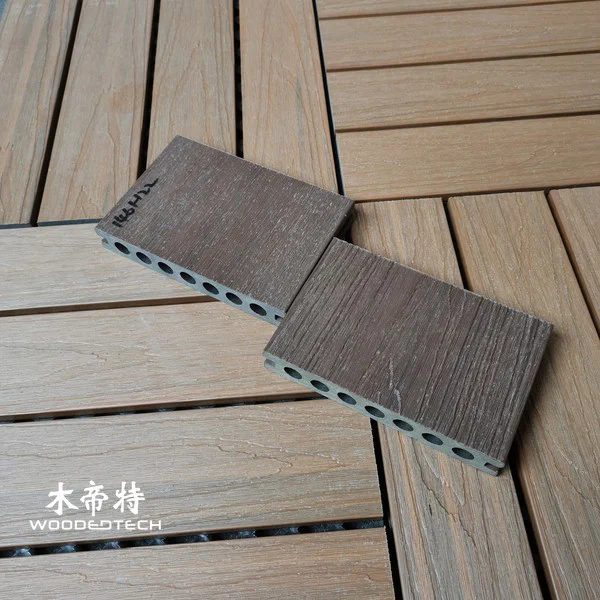
The GD14622 Decking in WPC Features a Classic Round Hole Co Extrusion Design That Has Remained Popular for Years
Explore how the GD14622 round-hole WPC co-extrusion decking design balances structural strength, material efficiency, manufacturing cost, and installation performance.
| Payment | T/T in advance. Customized order: T/T, 50% prepayment, 50% balance before loading. |
|---|---|
| Transaction Terms | FOB, CIF, EXW, etc. |
| Samples | <30cm: samples for free. >30cm: samples order (the sample fee can be deducted when placing a container order later). |
| Length | For 20GP container, max length is 5.8 meters (longest); mostly 2.2 / 2.4 / 2.9 / 3.0 / 4.0 meters (recommended) or customized. |
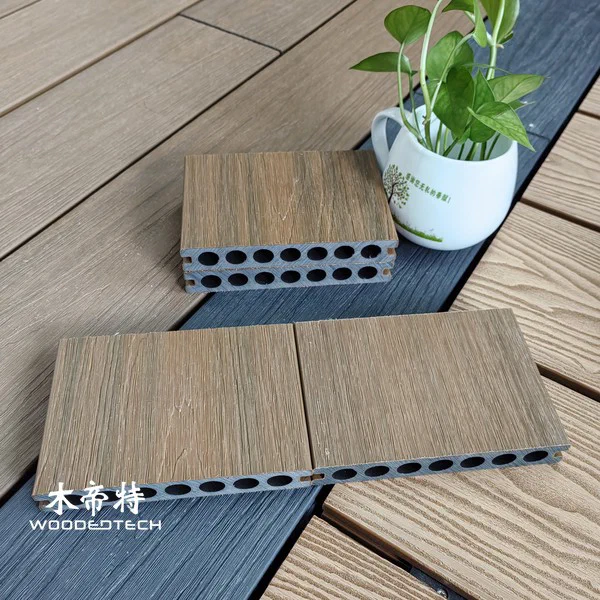
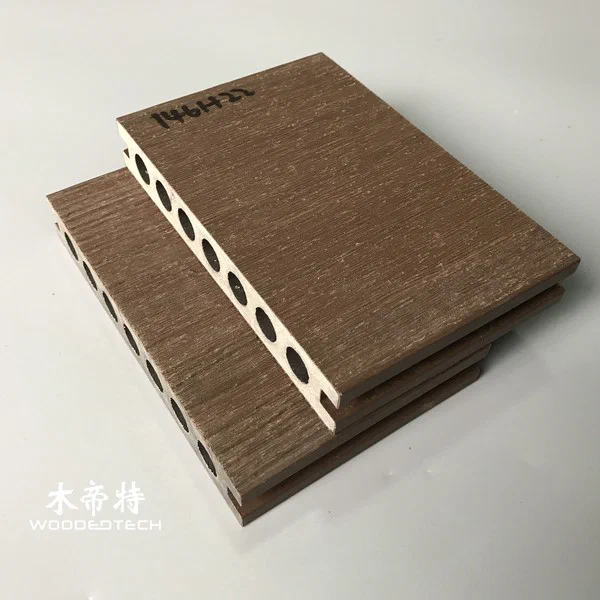
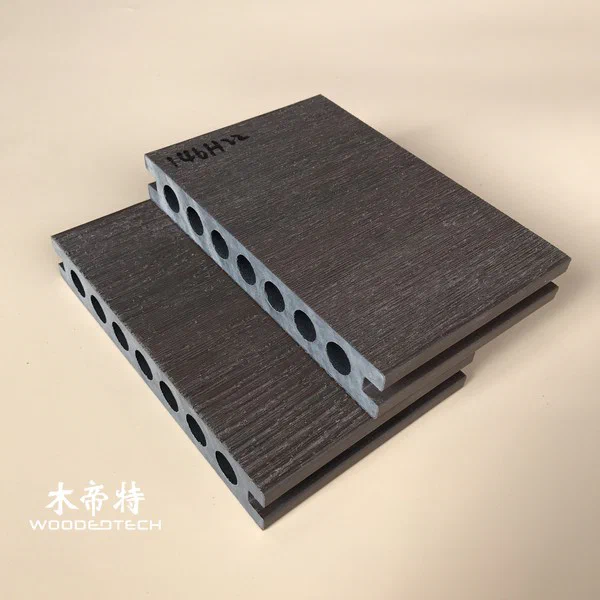
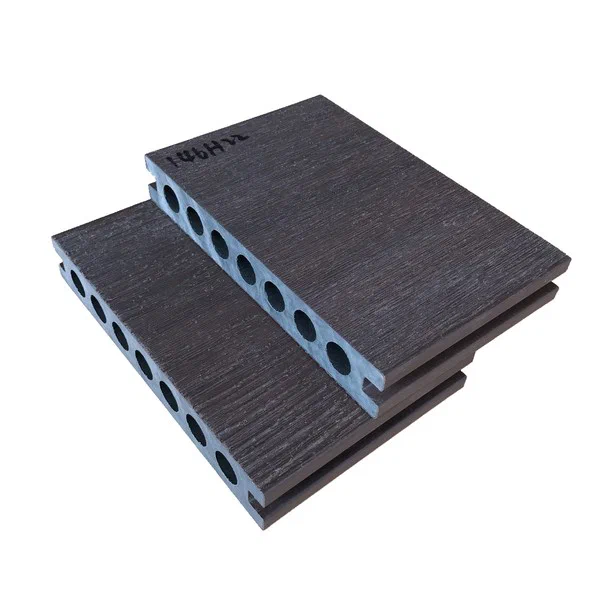
The GD14622 WPC decking profile features a classic round-hole hollow structure combined with a co-extruded protective surface. This design has remained popular for years because it offers a practical balance of structural strength, material efficiency, manufacturing stability, and installation convenience. From an extrusion mold design perspective, its long-standing appeal comes from how the internal geometry and external surface work together to meet everyday decking requirements.
Why the GD14622 Round-Hole Structure Remains Popular
The GD14622 uses a hollow profile with round internal cavities rather than a completely solid cross-section. This structural approach reduces material consumption while retaining sufficient rigidity for typical decking applications when the wall thickness, cavity diameter, and support spacing are properly engineered.
Round holes are particularly suitable for WPC extrusion because their geometry distributes material relatively evenly around each cavity. Compared with profiles containing sharp internal corners, circular openings generally create fewer stress concentration points. They also allow the extrusion material to flow more consistently through the mold, helping maintain dimensional stability and reducing the risk of uneven wall thickness.
For manufacturers, this design offers another advantage: predictable production. A well-designed round-hole extrusion mold can maintain a stable cross-section over continuous production runs, provided that the screw configuration, melt temperature, cooling conditions, and extrusion speed are properly controlled. This makes the GD14622 a practical profile for manufacturers seeking consistent product quality.
Hollow vs. Solid WPC Decking: Strength, Weight, and Cost
The choice between hollow and solid structures directly affects the performance and manufacturing cost of WPC decking boards.
Hollow decking profiles, such as the GD14622, use internal cavities to reduce the amount of raw material required. Lower material consumption can reduce board weight, transportation expenses, and overall production costs. The reduced weight also makes handling and installation easier, particularly for large projects involving substantial quantities of decking boards.
However, hollow construction requires careful structural design. If the cavity diameter is too large or the surrounding walls are too thin, the board may become vulnerable to localized deformation, impact damage, or excessive deflection under concentrated loads. The extrusion mold must therefore balance cavity size, outer wall thickness, and internal material distribution.
Solid WPC decking offers a different performance profile. Its continuous cross-section generally provides greater resistance to localized impact and can be suitable for applications requiring heavier-duty construction. However, it consumes more raw material, increases product weight, and may require additional attention to cooling and dimensional control during extrusion.
Neither structure is automatically superior. Hollow profiles are often attractive for cost-conscious residential and general outdoor decking projects, while solid profiles may be preferred where specific load or impact requirements justify the additional material.
How Rib Design Influences Structural Performance
Although round holes reduce material usage, the ribs and connecting walls surrounding them determine how effectively the profile carries loads.
In the GD14622 design, the internal walls separate the cavities and connect the upper and lower surfaces. These walls help maintain the cross-sectional shape and transfer loads through the profile. Their thickness and positioning influence bending resistance, stiffness, and resistance to localized compression.
From a mold engineering perspective, rib design must also account for melt flow. Excessively thin ribs can restrict material movement and create inconsistent filling, while unnecessarily thick sections may produce uneven cooling and internal stress. Both situations can affect the finished board’s dimensional accuracy and long-term performance.
The spacing between cavities is equally important. Properly positioned ribs provide structural support without consuming excessive material. During mold development, engineers should evaluate the profile through cross-sectional analysis, flow assessment, and practical load testing rather than relying on appearance alone.
For buyers sourcing custom WPC decking, reviewing the internal cross-section is therefore just as important as comparing the external dimensions.
Co-Extrusion Surface Design and Long-Term Protection
The GD14622 combines its hollow core with co-extrusion technology, adding a protective outer layer during the extrusion process. Unlike conventional single-layer WPC decking, co-extruded boards have a functional surface layer designed to improve resistance to environmental exposure.
Depending on the formulation and production process, this outer layer can improve resistance to moisture absorption, UV exposure, staining, and surface wear. It also provides greater flexibility in developing different colors and wood-grain finishes.
The interface between the protective layer and the WPC core is a critical engineering consideration. Material compatibility, extrusion temperature, layer thickness, and bonding conditions must be carefully controlled to achieve consistent adhesion. Poor process control can result in uneven coating distribution or separation between layers.
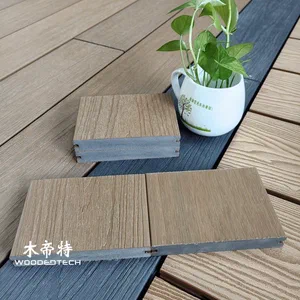
Surface patterns also influence practical performance. Embossed wood-grain textures create a more natural appearance and can provide additional surface traction compared with smooth finishes. However, deeper patterns require appropriate mold and calibration design to ensure consistent texture reproduction without compromising the protective layer.
How Profile Design Affects Installation Performance
A well-designed decking profile should perform effectively not only during use but also throughout installation. The GD14622’s hollow construction helps reduce handling weight, making boards easier to transport, position, and cut on-site.
The profile’s external dimensions, side grooves, and fastening interfaces must also be compatible with the selected clip system and supporting joists. Consistent dimensional tolerances are particularly important because variations in board width or groove geometry can complicate installation and create uneven gaps.
For extrusion manufacturers, maintaining a stable profile requires coordinated control of mold dimensions, vacuum calibration, cooling, and haul-off speed. For installers, following the recommended joist spacing, expansion gaps, fastening method, and drainage requirements is essential to achieving a stable finished deck.
Why GD14622 Remains a Practical Manufacturing Choice
The continued popularity of the GD14622 reflects a straightforward engineering principle: effective decking design is about balancing performance with material efficiency. Its round-hole hollow structure helps reduce weight and raw material consumption, while its internal ribs provide the necessary structural support when properly proportioned. Co-extrusion adds an additional protective surface, allowing manufacturers to combine an efficient core with improved outdoor surface performance.
For WPC decking manufacturers, the profile also offers a practical foundation for consistent extrusion production and product customization. Adjustments to cavity geometry, wall thickness, surface texture, and protective layer formulation can be evaluated to meet different market requirements without losing the advantages of the established profile concept.
When selecting or developing a WPC decking extrusion mold, the most important consideration is not simply whether a profile is hollow or solid. It is how the complete cross-section, material formulation, co-extrusion process, and installation system work together. This engineering balance is what makes the GD14622 round-hole co-extrusion design a reliable and enduring choice for outdoor decking applications.
Related Products
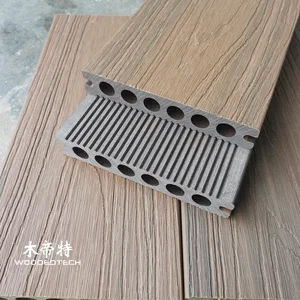 The GD14023 Best Composite Decks Feature a Single-Sided Co Extrusion Surface with a Classic Round Hole Structure for Outdoor Applications
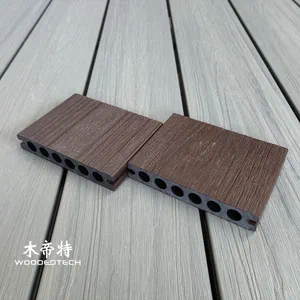 GD13823-3 Redwood Color Round Hole Co Extrusion Decking Composite Decking Brings Classic Chinese Red Style to Outdoor Flooring Projects
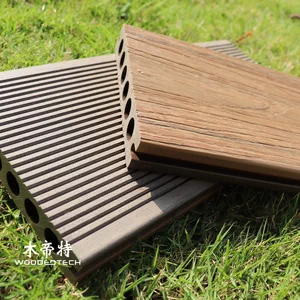 GD14023 Second Generation Semi Capped Co Extrusion Wood Plastic Composites WPC Decking Features a Classic Round Hole Design for Outdoor Flooring
 The GD14020S Composite Decking on Sale Features a Solid Core Structure Designed to Withstand Extreme Outdoor Temperature Changes and Freezing Conditions
Related Articles

Get a Free Quote
Interested in The GD14622 Decking in WPC Features a Classic Round Hole Co Extrusion Design That Has Remained Popular for Years? Fill in the form and we will reply within 24 hours.