


D14025-4 Teak Hollow Square Hole Composite Decking Provides G3 Wood Grain Surface Design with Flat Finish
Explore how D14025-4 Teak Hollow Square Hole Composite Decking uses WPC profile engineering for strength, efficiency, and wood grain beauty.
| Payment | T/T in advance. Customized order: T/T, 50% prepayment, 50% balance before loading. |
|---|---|
| Transaction Terms | FOB, CIF, EXW, etc. |
| Samples | <30cm: samples for free. >30cm: samples order (the sample fee can be deducted when placing a container order later). |
| Length | For 20GP container, max length is 5.8 meters (longest); mostly 2.2 / 2.4 / 2.9 / 3.0 / 4.0 meters (recommended) or customized. |
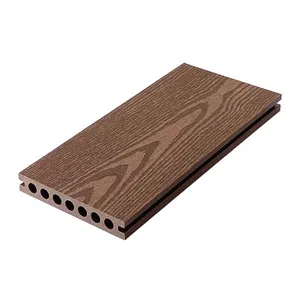
:::writing{variant=“document” id=“58391” title=“D14025-4 Teak Hollow Square Hole Composite Decking Provides G3 Wood Grain Surface Design with Flat Finish”} D14025-4 Teak Hollow Square Hole Composite Decking is engineered with a balanced hollow square structure, G3 wood grain surface design, and flat finish to deliver reliable outdoor performance with reduced material usage. Its profile design demonstrates how WPC extrusion technology can optimize strength, weight, appearance, and installation efficiency.
Profile Design and Structural Performance
As a WPC extrusion mold design engineer, profile geometry is one of the most important factors in determining decking performance. The D14025-4 profile uses a hollow square hole structure that reduces overall weight while maintaining sufficient load-bearing capacity. The internal cavities improve material efficiency and help manufacturers control production costs without sacrificing outdoor durability.
Compared with solid composite decking, hollow profiles require less raw material and are easier to handle during transportation and installation. However, the size, shape, and distribution of the hollow sections must be carefully designed. Square holes provide consistent wall thickness and stable support, helping reduce deformation caused by temperature changes and long-term outdoor exposure.
Hollow and Solid Structure Comparison
Solid composite decking offers maximum density and is often selected for areas requiring higher impact resistance. Hollow WPC decking, including D14025-4, focuses on achieving a practical balance between strength and economy. Proper extrusion mold design ensures that the hollow structure maintains enough rigidity for residential decks, balconies, gardens, and commercial outdoor spaces.
The key is not simply adding empty space inside the board. Engineers must calculate rib placement, material flow during extrusion, and stress distribution. A well-designed hollow structure can provide excellent mechanical performance while reducing weight and improving installation convenience.
Rib Design and Surface Pattern Influence
Internal ribs act as reinforcement elements inside the decking profile. They increase stiffness, support fastening systems, and help maintain dimensional stability. The arrangement of ribs directly affects how the board performs under pressure, foot traffic, and environmental changes.
The exterior surface also plays an important role. D14025-4 features a G3 wood grain surface design with a flat finish, creating a natural teak appearance while maintaining a clean and modern visual effect. Surface patterns are developed through extrusion mold texture technology, allowing manufacturers to achieve realistic wood details while improving slip resistance and user experience.
Installation Benefits and Manufacturing Value
A lightweight hollow profile makes handling easier for installers and reduces labor intensity on large projects. The optimized structure also supports efficient packaging and shipping, creating advantages for international WPC suppliers and distributors.
D14025-4 Teak Hollow Square Hole Composite Decking represents a practical combination of engineering design and aesthetic requirements. Through controlled profile dimensions, reinforced internal structures, and detailed surface finishing, WPC decking can achieve dependable performance with competitive production costs.
FAQ
Q: Why is hollow structure used in WPC decking profiles? A: Hollow structures reduce material consumption and weight while maintaining suitable strength through optimized internal design.
Q: How does a G3 wood grain surface improve composite decking? A: A G3 wood grain surface provides a realistic teak appearance and enhances the visual quality of outdoor decking applications.
Q: What factors affect the strength of WPC decking? A: Profile shape, wall thickness, rib arrangement, material formulation, and extrusion mold precision all influence decking strength.
:::
Related Products
 D14025-6 Teak Color Grooved Composite Decking with Six Round Holes Provides a Popular Solution for Outdoor Flooring
 D15030 Hollow Square Hole Wood Plastic Composite Decking Features Double Grooved Sides for Outdoor Flooring Projects
 Y4030S Solid I Shaped Composite Deck Joist Provides Reliable Support for Outdoor Decking Systems
 D13823 Classic Round Hole Hollow Decking Composite: Elegant Design & Easy Installation
Related Articles

Get a Free Quote
Interested in D14025-4 Teak Hollow Square Hole Composite Decking Provides G3 Wood Grain Surface Design with Flat Finish? Fill in the form and we will reply within 24 hours.