


Φ200 extra large round column is rarely produced by manufacturers with technology for fake wood plastic outdoor structures
Learn how WPC profile geometry, ribs, hollow cores, and surface textures shape strength, cost, weight, and installation for large round columns.
| Payment | T/T in advance. Customized order: T/T, 50% prepayment, 50% balance before loading. |
|---|---|
| Transaction Terms | FOB, CIF, EXW, etc. |
| Samples | <30cm: samples for free. >30cm: samples order (the sample fee can be deducted when placing a container order later). |
| Length | For 20GP container, max length is 5.8 meters (longest); mostly 2.2 / 2.4 / 2.9 / 3.0 / 4.0 meters (recommended) or customized. |
Φ200 extra large round column is rarely produced by manufacturers with technology for fake wood plastic outdoor structures
Φ200 extra large round columns are a niche WPC extrusion product because the diameter pushes both tooling limits and structural design limits at the same time. For fake wood outdoor structures, the profile has to look convincing, stay stable in sun and rain, and still be practical to manufacture, transport, and install.
How profile shape changes performance
In WPC extrusion, geometry is not just a visual choice. A round column with a 200 mm diameter has a very different stress pattern from a flat board or square post, so wall thickness, internal support, and material flow must be controlled carefully. If the section is too thin, it may deform under load or during cooling; if it is too thick, cost rises fast and extrusion becomes harder to stabilize.
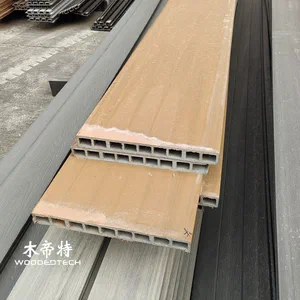
Hollow structures are usually preferred when weight and material cost matter. They reduce resin and wood-fiber usage, lower freight cost, and make handling easier on site. The tradeoff is that hollow columns need proper rib layout and wall distribution, or they can lose stiffness and show local buckling around fasteners, clamps, or joints.
Solid structures deliver better impact resistance and simpler processing, especially for short components or heavy-duty decorative pieces. They are less sensitive to connection points and can feel more substantial during installation. The downside is clear: higher material consumption, more shrinkage risk, and greater production cost, which is why fully solid Φ200 columns are rarely the first choice unless the application demands maximum rigidity.
Why rib design matters
Ribs are the hidden structure that determines whether a large round column behaves like a stable architectural member or just a thick shell. Well-placed ribs increase bending resistance without adding the full weight of a solid section. They also help control ovality during cooling and reduce the chance of collapse in the vacuum sizing stage.
For extra large columns, rib design must also support assembly. Internal ribs can create cleaner screw zones, help align decorative caps, and improve anchoring for mounting brackets. Poor rib design does the opposite: it traps stress, makes extrusion unstable, and complicates cutting or drilling at the job site.
Surface pattern and installation performance
Surface pattern affects more than appearance. A deep wood grain, brushed texture, or embossed pattern can improve the fake wood effect, but it also changes how easily the profile releases from the die and how consistently it cools. Fine surface detail can hide minor extrusion marks, while overly aggressive texture may collect dirt or make cleaning harder on outdoor structures.
Installation performance depends on dimensional stability as much as looks. Round columns must hold diameter tolerance, straightness, and concentricity so that sleeves, bases, and decorative connectors fit correctly. If the surface pattern is too deep or the wall thickness varies too much, installers will spend more time adjusting parts, and the project cost rises even if the material price seems acceptable.
Practical design balance
For a Φ200 fake wood outdoor column, the best design is usually a controlled hollow structure with reinforced ribs, moderate wall thickness, and a surface treatment that balances realism with manufacturability. That combination keeps weight manageable, supports faster installation, and gives manufacturers a product that is still commercially viable at large scale.
FAQ
Q: Why are Φ200 round WPC columns difficult to produce? A: The large diameter makes wall thickness control, cooling, and shape stability much harder than with standard profiles. Small defects become more visible and more expensive to fix.
Q: Is a hollow WPC column strong enough for outdoor use? A: Yes, if the wall structure and rib layout are engineered correctly for the intended load. For decorative and semi-structural applications, hollow designs are usually the best balance.
Q: Does deeper wood grain texture improve product quality? A: It improves visual realism, but only when the extrusion process can reproduce it cleanly. Too much texture can raise tooling difficulty and make cleaning harder.
Related Products
 F5030 outdoor solid square decorative bar is widely used for garden products and decking composite joists
 T12149 is used as outdoor plastic wood gazebo ridge tile board with wpc lumber for exterior structures
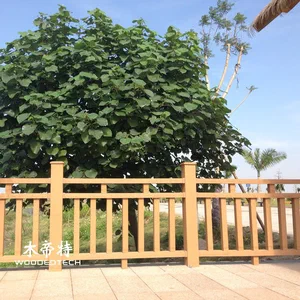
 Composite deck with wood railing offers high customization options for different outdoor design requirements
 T4040 is an uncommon L shape right angle decorative edge trim used for wpc panel outdoor applications
Related Articles
Get a Free Quote
Interested in Φ200 extra large round column is rarely produced by manufacturers with technology for fake wood plastic outdoor structures? Fill in the form and we will reply within 24 hours.