
WPC Hohl oder Massiv: Key Differences for Industrial Applications
WPC hollow and solid profiles serve different industrial requirements, and the right choice depends on load capacity, product dimensions, material consumption, and installation conditions. For extrusion mold designers and WPC manufacturers, profile geometry is just as important as material formulation because it directly affects structural strength, finished product weight, production cost, and long-term performance.
Understanding Hollow and Solid WPC Profiles
Hollow WPC profiles contain internal cavities that reduce material consumption while maintaining a defined external shape. They are widely used in outdoor decking, wall cladding, fencing, louvers, and decorative architectural components. Their performance depends on cavity dimensions, wall thickness, rib placement, and the distribution of material across the profile.
Solid WPC profiles have a continuous cross-section without internal cavities. Their greater material volume generally provides higher resistance to localized impact, screw pull-out, and concentrated loads. However, they also require more raw material, increase product weight, and may take longer to cool during extrusion.
For industrial applications, neither structure is automatically superior. Hollow profiles are often more economical for large sections where weight reduction matters, while solid profiles are suitable for components requiring greater local strength and reliable mechanical fastening.
How Profile Geometry Influences Structural Strength
Profile geometry determines how forces travel through a WPC product. A well-designed hollow profile can achieve a favorable strength-to-weight ratio by positioning material where it contributes most to bending resistance.
For example, a hollow decking board with sufficiently thick upper and lower walls can resist bending effectively because these walls are separated by internal cavities. The distance between the outer walls helps improve the section’s resistance to bending without filling the entire cross-section with material.
Solid profiles distribute material throughout the section, making them less dependent on internal wall arrangements. This can be advantageous for narrow components, support blocks, stair elements, and applications exposed to concentrated loads.
However, strength cannot be judged by cross-sectional appearance alone. Designers should evaluate bending strength, deflection, impact resistance, creep, screw retention, and environmental aging. Material formulation, wood flour content, polymer type, coupling agents, and extrusion quality all influence the final mechanical properties.
Hollow Structures and Rib Designs: Reducing Weight Without Sacrificing Performance
The internal structure is one of the most important considerations when designing a hollow WPC extrusion mold. Simply increasing the number of cavities does not guarantee better performance. Excessively thin walls can deform during cooling, crack under impact, or create inconsistent extrusion pressure.
A practical hollow profile design should consider:
- Outer wall thickness: Provides the primary structural surface and helps resist impact and bending.
- Internal ribs: Support the outer walls, reduce unsupported spans, and improve resistance to deformation.
- Cavity arrangement: Determines material distribution, weight reduction, and structural balance.
- Rib spacing: Influences load transfer and helps prevent local buckling.
- Corner geometry: Rounded internal transitions can reduce stress concentration and improve material flow.
Rib designs are particularly important in wide decking boards and large-format wall panels. Long unsupported cavities may allow the surface to flex under foot traffic or installation pressure. Adding strategically positioned ribs improves stiffness while keeping material consumption lower than that of a fully solid profile.
From an extrusion mold engineering perspective, rib thickness and spacing must also support stable melt flow. Uneven flow resistance can cause dimensional variation, internal stress, or inconsistent wall thickness. The die design, calibration system, cooling arrangement, and haul-off speed must work together to maintain a consistent cross-section.
Surface Patterns and Their Impact on Installation Performance
Surface patterns influence more than appearance. Embossed wood grain, grooves, fluted textures, and anti-slip patterns can affect friction, drainage, cleaning, and installation requirements.
For WPC decking, grooves and textured surfaces can improve traction, while properly designed drainage channels help prevent standing water. However, excessively deep patterns may reduce the effective surface thickness and create areas where dirt and moisture accumulate.
For wall cladding and decorative panels, fluted or embossed surfaces create visual depth and can help conceal minor surface imperfections. These patterns also influence mold complexity and the consistency of the finished surface.
Manufacturers should consider the relationship between surface design and profile structure. A deeply embossed pattern on a thin hollow wall may produce uneven surface definition or local deformation. Surface details must therefore be coordinated with the underlying wall thickness and extrusion process.
Installation performance also depends on how the profile connects to supporting structures. Grooved decking boards may require compatible hidden fasteners, while solid profiles can offer greater flexibility for direct screw fixing. Hollow profiles may need reinforced fastening zones or specially designed clips to prevent crushing around fixing points.

Comparing Weight, Material Cost, and Production Efficiency
Material consumption is a major difference between hollow and solid WPC products. For profiles with similar external dimensions, hollow designs generally use less compound per meter, reducing raw material costs and finished product weight.
| Design factor | Hollow WPC | Solid WPC |
|---|---|---|
| Material consumption | Lower | Higher |
| Finished weight | Lighter | Heavier |
| Bending performance | Depends on wall and rib design | Generally consistent |
| Impact resistance | Depends on wall thickness | Often better locally |
| Screw retention | May need reinforcement | Generally easier |
| Cooling requirements | Geometry-dependent | Often longer |
| Transportation | Lower weight per piece | Higher weight per piece |
| Mold complexity | Generally higher | Generally simpler |
Production cost should not be calculated from material consumption alone. Hollow profiles require more complex extrusion dies, internal flow balancing, and careful calibration. Solid profiles may be easier to extrude but consume more material and require additional cooling capacity.
For high-volume manufacturing, the best design is the one that balances compound consumption, extrusion speed, dimensional stability, scrap rate, and downstream installation requirements.
Choosing the Right Profile for Industrial Applications
The selection process should start with the product’s actual operating conditions rather than a preference for hollow or solid construction.
Hollow structures are suitable for lightweight decking, decorative cladding, privacy screens, fencing, and architectural louvers where reducing material consumption is important. Ribbed designs are especially useful when larger cross-sections need additional stiffness without significantly increasing weight.
Solid structures are more appropriate for compact structural components, high-impact areas, stair treads, support elements, and applications requiring reliable mechanical fastening. In some projects, a hybrid design combining hollow sections with reinforced solid fastening zones offers a better balance.
For WPC extrusion mold manufacturers, early cooperation between product designers, material engineers, and mold engineers is essential. Cross-sectional drawings should be evaluated for wall thickness, rib distribution, cavity proportions, shrinkage, cooling behavior, and fastening details before mold production begins. Prototype extrusion and mechanical testing can then verify whether the design meets the required specifications.
A successful WPC profile is not simply the one that uses the least material or has the thickest walls. It is the one that delivers the required strength, weight, surface quality, production efficiency, and installation reliability at a competitive manufacturing cost.
Related Articles


Related Products
 GD13823-3 Composite Boards for Decking Are Available in Multiple Stock Colors with 3 Meter Lengths and Single Piece Delivery
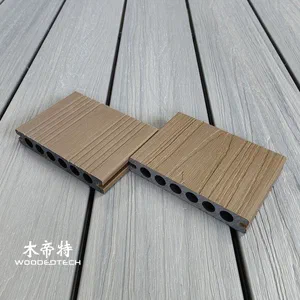 GD13823-3 Teak TK Co Extruded Decking Is a Popular Choice from Composite Decking Suppliers for Outdoor Flooring Projects
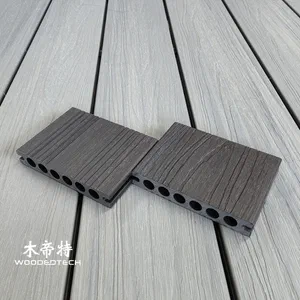 GD13823-3 Walnut WN Co Extruded Decking Features a Dark Rich Color That Helps Resist Visible Dirt and Stains