
WPC Decking: A Comprehensive Guide to Manufacturing, Performance, and Applications
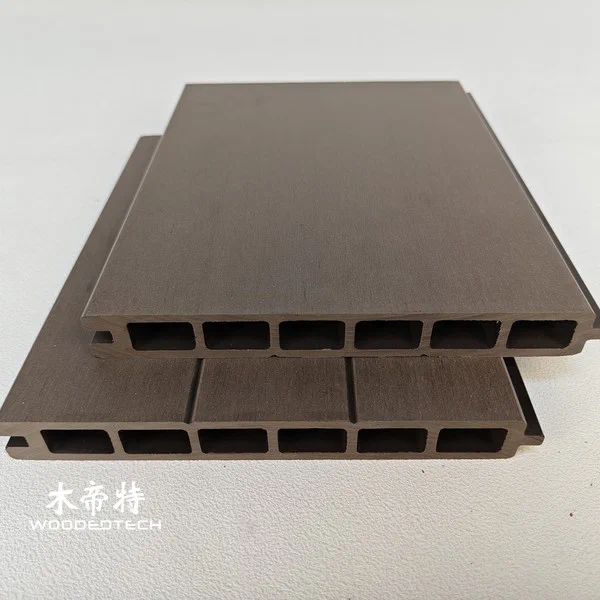
WPC decking is a practical outdoor flooring solution that combines wood fibres and thermoplastics to create boards with the appearance of natural timber and improved resistance to moisture, decay and everyday weather exposure. As an outdoor WPC manufacturer based in Guangdong, China, with more than 10 years of production experience, we understand that reliable decking starts with material selection, controlled manufacturing processes and consistent quality management.
Understanding WPC Decking Materials
Wood plastic composite (WPC) decking is manufactured by combining wood flour or wood fibres with thermoplastic materials, commonly HDPE or other suitable polymers. Additives are incorporated to improve processing stability, weather resistance, colour consistency and mechanical performance.
The quality of the finished board depends on more than the basic formula. Wood flour moisture content, particle size, polymer quality and additive compatibility all influence extrusion stability and final product performance. A poorly balanced formula can lead to surface defects, inconsistent dimensions, excessive expansion or reduced impact resistance.
In our Guangdong factory, material selection is treated as the foundation of production. We pay particular attention to the consistency of incoming raw materials and the balance between wood content and polymer content. Different applications require different formulations. Residential garden decking, commercial walkways and poolside installations do not necessarily need identical material specifications.
Using the right formulation for the intended environment helps manufacturers deliver products that meet customer expectations without unnecessarily increasing production costs.
How WPC Decking Is Manufactured
Manufacturing WPC decking requires coordinated control over several production stages. Each stage affects the appearance, dimensional accuracy and long-term performance of the finished boards.
The process generally includes:
- Raw material preparation: Wood flour is dried to an appropriate moisture level, while polymers and additives are measured according to the production formula.
- Mixing and compounding: The ingredients are blended to achieve a consistent distribution of wood fibres, polymer and functional additives.
- Extrusion: The composite material is heated and pushed through a specially designed mould to form the required decking profile.
- Cooling and calibration: Vacuum calibration and controlled cooling help maintain board dimensions and profile stability.
- Surface treatment: Embossing, brushing, sanding or co-extrusion can be applied to achieve different textures and performance characteristics.
- Cutting and inspection: Boards are cut to the required lengths, checked for defects and prepared for packaging.
Extrusion is one of the most important stages. Temperature settings, screw speed, material feeding and cooling conditions must work together. Small changes can affect surface quality, internal structure and dimensional consistency.
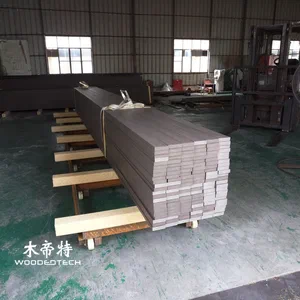
With more than a decade of manufacturing experience, we recognise that production stability comes from repeatable processes rather than occasional adjustments. Maintaining suitable production parameters across different batches is essential for dependable wholesale supply.
Performance Characteristics and Surface Technologies
Outdoor WPC decking is valued for its combination of timber-like appearance and practical maintenance advantages. Compared with untreated natural wood, properly manufactured WPC boards are less vulnerable to moisture-related decay, splintering and insect damage. They also do not require routine staining or painting.
However, WPC decking should not be described as completely maintenance-free or immune to environmental changes. Temperature fluctuations can cause expansion and contraction, while prolonged exposure to sunlight may gradually affect colour. Board performance also depends on the material formulation, manufacturing quality and installation conditions.
Different surface technologies provide additional options for buyers.
Traditional embossed decking offers a textured wood-grain appearance that works well in residential gardens, terraces and outdoor leisure areas. Brushed surfaces provide a more understated finish, while 3D embossing creates deeper, more realistic timber patterns.
Co-extrusion technology is another important development. It involves forming a protective polymer-rich outer layer around the composite core during production. This structure can improve resistance to staining, moisture penetration and surface wear, depending on the coating formulation and manufacturing quality.
For buyers comparing capped and uncapped products, the main consideration should be the intended application, expected maintenance requirements and overall project budget. A higher-priced surface treatment is not automatically necessary for every installation.
Quality Control and Manufacturing Standards
For a professional WPC decking manufacturer, quality control must cover the entire production process rather than simply inspecting finished boards before shipment.
Our quality philosophy focuses on preventing defects at their source. Raw materials are checked before production, mixing ratios are controlled, and extrusion conditions are monitored throughout manufacturing. Finished products are then inspected for appearance, dimensions and structural consistency.
Important quality considerations include:
- Dimensional accuracy and profile consistency.
- Surface finish, colour uniformity and texture quality.
- Flexural strength and impact resistance.
- Water absorption and resistance to environmental exposure.
- Thermal expansion and dimensional stability.
- Batch-to-batch consistency.
Testing requirements should reflect the destination market and intended application. For export projects, buyers may require specific test reports, technical data sheets or compliance documentation. We encourage customers to confirm these requirements before production so that the appropriate materials and testing arrangements can be established.
A reliable supplier should also be transparent about product limitations. For example, installation gaps, suitable substructures, drainage and ventilation all influence the service life of outdoor decking. Even high-quality boards can experience problems when installed incorrectly.

Applications Across Residential and Commercial Projects
WPC decking is suitable for a wide range of outdoor environments where a timber appearance and relatively straightforward maintenance are desired.
Residential applications include garden pathways, balconies, patios, swimming pool surrounds and rooftop terraces. Commercial applications include hotel outdoor areas, restaurant terraces, resort walkways, public recreation spaces and landscaped developments.
For poolside installations, buyers should pay particular attention to surface texture, drainage and slip-resistance test results. For commercial projects with heavier foot traffic, load-bearing performance, joist spacing and fastening systems deserve greater consideration.
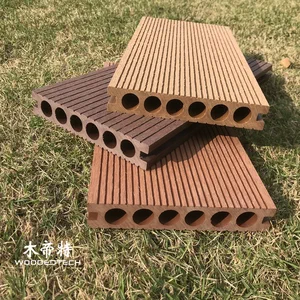
We also manufacture different decking profiles to accommodate varying project requirements. Hollow boards can reduce material consumption and product weight, while solid boards may be appropriate for applications requiring different structural characteristics. Neither option is universally superior; the correct choice depends on span, support conditions, loading and installation design.
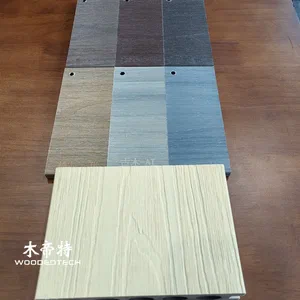
Colour, board dimensions, surface texture and profile design can also be adjusted to suit different architectural styles and regional preferences.
Working with a Guangdong WPC Manufacturer
Choosing a manufacturing partner involves more than comparing quotations. Buyers need a supplier capable of maintaining product consistency, communicating clearly and supporting projects from initial sampling through bulk production.
As a Guangdong-based outdoor WPC manufacturer with over 10 years of experience, we work with importers, distributors, wholesalers, contractors and project developers. Our cooperation can cover standard product supply as well as OEM and customised manufacturing.
For new projects, we recommend starting with the application and technical requirements rather than selecting products based on appearance alone. Important details include the installation environment, expected loading, preferred board dimensions, surface finish, colour, order quantity and destination market.
Samples allow buyers to evaluate texture, colour and workmanship before committing to larger orders. Once specifications are confirmed, production planning and quality inspection can follow an agreed standard. Clear communication about packaging, lead times, shipping arrangements and documentation also helps avoid unnecessary delays.
A good manufacturing relationship should be built on realistic specifications, transparent pricing and consistent delivery. We believe long-term cooperation depends on supplying products that perform as expected, responding promptly to customer concerns and continuously improving manufacturing processes.
WPC decking continues to develop as material technology and outdoor architectural requirements evolve. For international buyers, the best investment is not simply the cheapest board or the most attractive surface. It is a product manufactured with a suitable formulation, reliable extrusion control and quality standards matched to its intended application.
Related Articles
Related Products
 GD13820 M Shape Co Extruded Composite Deck Planks Feature a Special Profile Design for Distinctive Outdoor Decking Applications
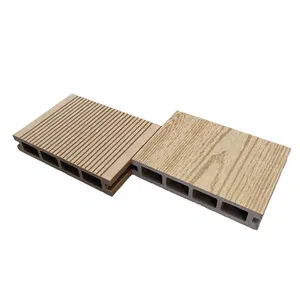
 GD13823 Double Sided Flat Surface Co Extruded WPC Decking Features a Popular Width and Thickness with Round Hollow Structure
 GD13823-3 Composite Boards for Decking Are Available in Multiple Stock Colors with 3 Meter Lengths and Single Piece Delivery