
Composite Deck vs Concrete: A Comparative Guide to Industrial Applications
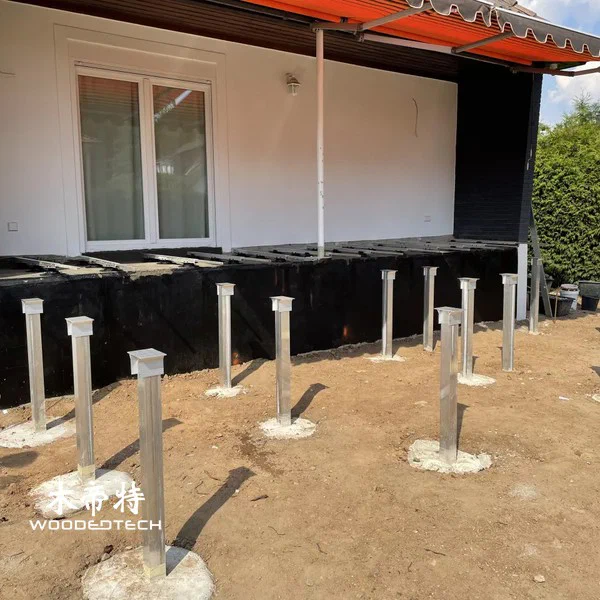
Composite decking and concrete are two widely used materials for outdoor industrial spaces, commercial facilities, loading areas, and public infrastructure. While concrete offers exceptional structural strength and load-bearing capacity, composite decking provides a more attractive, comfortable, and lower-maintenance surface for applications where pedestrian access, weather resistance, and long-term appearance matter.
Choosing between composite deck and concrete requires more than comparing initial material prices. Project owners should consider structural requirements, installation costs, maintenance schedules, service life, environmental exposure, and the total cost of ownership.
1. Material Composition and Performance Differences
Composite decking, commonly known as wood plastic composite (WPC), is manufactured by combining wood fibers or wood flour with thermoplastics and additives. The resulting material offers a wood-like appearance with improved resistance to moisture, insects, and everyday outdoor exposure. Depending on the manufacturing process, composite boards may feature solid or hollow profiles, textured surfaces, protective caps, and different levels of UV resistance.
Concrete is a mixture of cement, water, sand, and aggregates. Reinforced concrete may also contain steel bars or mesh to improve tensile performance. Its primary advantages are compressive strength, dimensional stability under properly designed structural conditions, and suitability for heavy-duty industrial environments.
The main difference is their intended function. Concrete is generally selected as a structural or load-bearing surface, while composite decking is primarily designed as an exterior flooring and finishing material. WPC should not be treated as a direct structural replacement for reinforced concrete.
2. Advantages and Disadvantages of Composite Decking
For industrial facilities with outdoor walkways, employee recreation areas, rooftop terraces, commercial entrances, and landscaped spaces, composite decking offers several practical benefits.
Key Advantages
- Moisture resistance: WPC absorbs less moisture than conventional timber, reducing problems associated with swelling, rot, and decay.
- Lower maintenance: Composite boards generally do not require regular staining, painting, or wood preservatives.
- Consistent appearance: Manufacturers can produce boards with uniform colors, textures, and wood-grain finishes.
- Installation flexibility: Different profiles and concealed fastening systems support a range of decking layouts.
- Surface comfort: Compared with concrete, composite decking can provide a more comfortable walking surface.
- Material efficiency: Many WPC products incorporate recycled plastics and reclaimed wood fibers.
Potential Disadvantages
Composite decking also has limitations that industrial buyers should evaluate before specifying it.
WPC boards expand and contract with temperature changes, so installers must follow the manufacturer’s requirements for expansion gaps, fastening, and substructure spacing. Lower-quality products may experience fading, surface damage, or deformation under excessive heat.
Composite decking can also have lower resistance to concentrated heavy loads than properly engineered concrete. It is therefore unsuitable for direct use as a heavy-duty forklift floor, industrial vehicle road, or foundation surface unless a separately engineered structural system supports the intended application.
3. Concrete vs Composite Decking: Cost and Lifecycle Comparison
Initial purchase price is only one part of an industrial flooring budget. Installation labor, foundation preparation, maintenance, repairs, and replacement schedules all influence long-term costs.

| Comparison Factor | Composite Decking | Concrete |
|---|---|---|
| Initial material cost | Generally higher than basic concrete | Generally economical for large areas |
| Installation | Requires framing and fastening systems | Requires preparation, pouring, and curing |
| Load-bearing capacity | Depends on board profile and support structure | High when properly engineered |
| Moisture resistance | Good, depending on formulation | Good, but vulnerable to water penetration and deterioration |
| Surface maintenance | Routine cleaning | Cleaning and periodic crack repairs |
| Repair requirements | Individual boards can often be replaced | Repairs may require patching or resurfacing |
| Design flexibility | Multiple colors and wood-grain textures | Various finishes and surface treatments |
| Walking comfort | Generally more comfortable | Hard and less forgiving |
| Expected service life | Product- and installation-dependent | Design- and exposure-dependent |
Concrete usually offers a lower initial cost per square meter for large industrial surfaces. However, cracking, joint maintenance, surface deterioration, and drainage problems can increase its long-term maintenance expenses.
Composite decking may require a higher initial investment because it needs supporting joists, clips, fasteners, and sometimes an additional substructure. Its advantage is reduced routine maintenance and the ability to replace damaged boards individually rather than reconstructing an entire surface.
A reliable lifecycle cost assessment should consider the following:
- Initial material and transportation costs.
- Foundation and substructure preparation.
- Installation labor and equipment.
- Routine cleaning and inspection.
- Expected repair and replacement expenses.
- Downtime and access restrictions during maintenance.
The actual financial advantage depends on project size, local labor rates, product quality, and environmental conditions. Buyers should request project-specific quotations rather than relying on material prices alone.
4. Comparing Composite Decking with Other Exterior Materials
Concrete and WPC are not the only options available for industrial exterior applications. Natural wood, treated timber, aluminum, and ceramic or porcelain paving may also be suitable depending on the project.
| Material | Main Advantages | Main Disadvantages | Maintenance |
|---|---|---|---|
| Natural wood | Authentic appearance and natural texture | Rot, insects, moisture damage | Regular sealing and staining |
| Treated timber | Relatively affordable and easy to work with | Can warp, crack, or deteriorate | Periodic inspection and treatment |
| Aluminum | Lightweight, corrosion-resistant grades available, and dimensionally stable | Higher material cost and metallic appearance | Occasional cleaning and inspection |
| Concrete | High compressive strength and excellent load-bearing potential | Heavy, hard, and susceptible to cracking | Cleaning and crack repairs |
| Composite decking | Low routine maintenance and wood-like appearance | Thermal expansion and load limitations | Cleaning and periodic inspection |
Natural wood provides an attractive finish but requires ongoing protection against moisture, insects, and UV exposure. Treated timber can improve durability, although its performance depends on treatment quality and installation conditions.
Aluminum is particularly useful for lightweight exterior structures, elevated platforms, and industrial access systems when properly engineered. However, its thermal conductivity, surface temperature, and higher material costs should be considered.
Ceramic and porcelain paving offer durable, decorative surfaces for pedestrian areas. Their performance depends on substrate stability, installation quality, drainage, and slip resistance.
For projects prioritizing appearance and reduced maintenance, WPC can offer a practical middle ground between natural timber and conventional hardscape materials.
5. Maintenance Requirements and Long-Term Durability
Maintenance planning has a direct influence on the lifecycle cost of exterior materials. Industrial environments often expose surfaces to dust, oil, chemicals, heavy foot traffic, temperature fluctuations, and standing water.
Composite decking generally requires periodic washing with water and a suitable cleaning solution. Leaves, dirt, and debris should be removed regularly, especially around board gaps and drainage areas. Inspections should also check fasteners, joists, expansion gaps, and signs of excessive deflection.
Concrete requires routine cleaning and inspection for cracks, damaged joints, surface scaling, and drainage problems. In industrial environments, chemical exposure and freeze-thaw cycles may accelerate deterioration. Protective sealers can help reduce certain forms of surface damage, depending on the concrete specification.
Natural timber needs more intensive maintenance, including protective coatings, moisture checks, and replacement of deteriorated boards. Aluminum generally requires less surface maintenance, although fasteners, connections, and protective finishes should be inspected periodically.
For WPC products, buyers should pay particular attention to UV resistance, water absorption, bending strength, slip resistance, and temperature performance. Product testing and installation documentation provide a more reliable basis for selection than appearance alone.
6. Choosing the Right Material for Industrial Applications
The best material depends on the actual function of the installation rather than its appearance or purchase price.
Concrete is generally the preferred option for warehouse floors, loading zones, vehicle access roads, equipment foundations, and other areas requiring substantial load-bearing capacity. Its structural performance makes it difficult to replace with conventional decking products.
Composite decking is better suited to pedestrian walkways, outdoor employee areas, commercial terraces, landscaped platforms, rooftop recreational spaces, and decorative exterior flooring. It can improve the visual quality of industrial facilities while reducing the maintenance associated with traditional timber.
A combined approach is often the most practical solution. For example, an industrial facility can use reinforced concrete for vehicle circulation and equipment zones while installing WPC decking around office entrances, outdoor seating areas, and pedestrian pathways.
Before purchasing, project developers should evaluate the intended loading conditions, local climate, fire-safety requirements, drainage design, slip resistance, and installation specifications. Working with an experienced WPC manufacturer can also help buyers select suitable board profiles, surface treatments, and custom dimensions.
The most cost-effective exterior material is not necessarily the one with the lowest purchase price. Matching material performance to actual operating conditions helps industrial property owners control maintenance expenses, extend service life, and create functional outdoor spaces.
Related Articles
Related Products
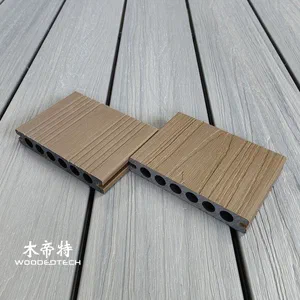 GD13823-3 Teak TK Co Extruded Decking Is a Popular Choice from Composite Decking Suppliers for Outdoor Flooring Projects
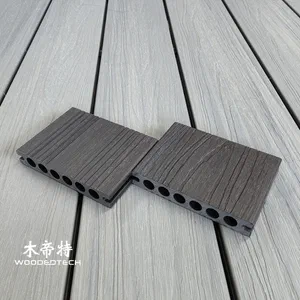 GD13823-3 Walnut WN Co Extruded Decking Features a Dark Rich Color That Helps Resist Visible Dirt and Stains
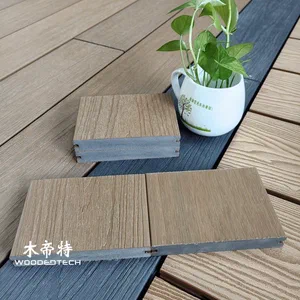 The GD14020S Composite Decking on Sale Features a Solid Core Structure Designed to Withstand Extreme Outdoor Temperature Changes and Freezing Conditions